Start with the bearing structure, then explore the original subtypes and filter actual records by brand, dimensions and technical attributes.
Original BearingScope download
Bearing types, classification and applications: PDF guide
Save a six-page English reference with a classification chart, eight common rolling-bearing families, real catalogue examples, application checks, plain and specialist bearing forms, and a model-search checklist.
Scope: an illustrated introduction, not an exhaustive catalogue, all-size chart, manufacturer manual or CAD drawing. The named models are construction examples, not machine-fitment recommendations.
6 pages · English · 1317 KB · Edition 1 · 2 October 2026
Names · structures · uses
Bearing types: a visual classification guide
Start by deciding what is being classified. Rolling versus plain describes the support principle; ball versus roller describes the rolling element; radial versus thrust describes the main load direction. These are different questions, so the number of bearing types changes with the level of the classification.
A classification chart: keep each question separate
Mechanical bearing principles
Rolling contact
Rolling elements between the supporting surfaces
Ball bearingsRoller bearings
Plain / sliding support
A sliding interface; its material and lubrication system matter
Journal / bushThrust / articulated forms
This is an orientation map, not an exhaustive catalogue of specialist systems. Load direction is a second classification axis:
A radial family can have specified axial capability; the exact design decides. “Thrust” is not a third rolling-element shape alongside ball and roller.
Why do lists say 2, 3, 4, 5 or 8 types?
Are there two main types of bearings?
For a basic mechanical comparison, use rolling bearings and plain (sliding) bearings. Within rolling bearings alone, the two element groups are ball and roller. Do not confuse these two different divisions.
What are three common bearing groups?
Ball, roller and plain bearings are a useful three-group introduction: the first two split the rolling branch, while plain bearings form the sliding branch. This is a teaching arrangement, not a rule that every specialist bearing system fits only three boxes.
What are four types of bearings?
Four examples are deep groove ball, angular contact ball, cylindrical roller and tapered roller bearings. If the question instead asks for four roller shapes, the answer is cylindrical, needle, tapered and spherical. The classification chart keeps those meanings separate.
What are five common types?
A short five-example list can use deep groove ball, angular contact ball, cylindrical roller, tapered roller and spherical roller bearings. It leaves out other important families; five is the length of that list, not the total number of bearing designs.
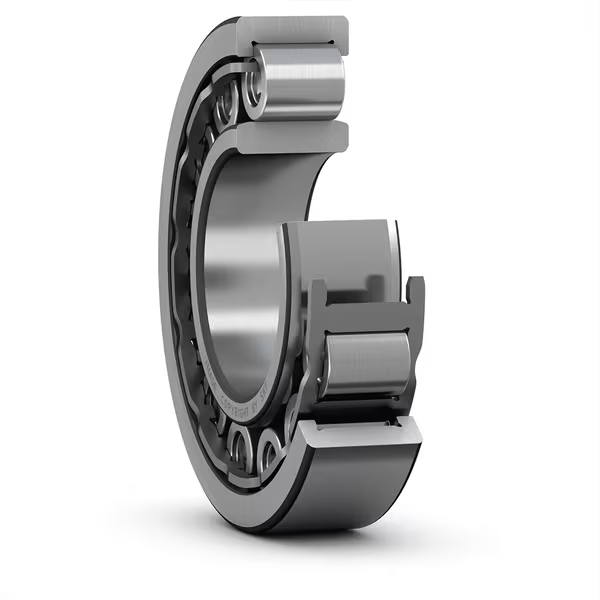
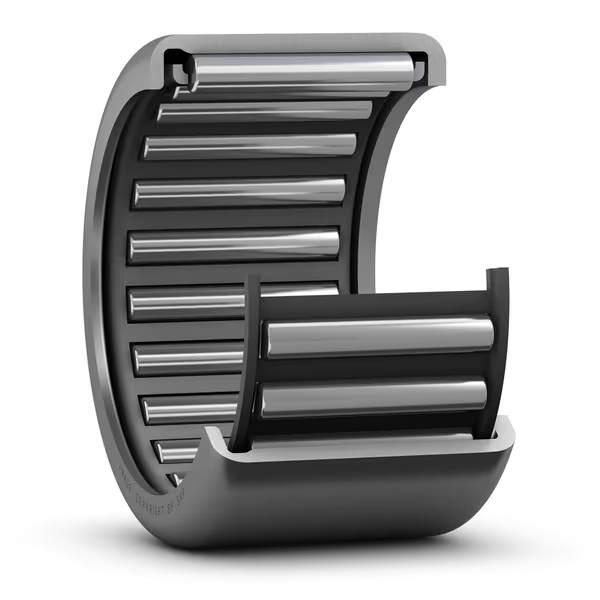
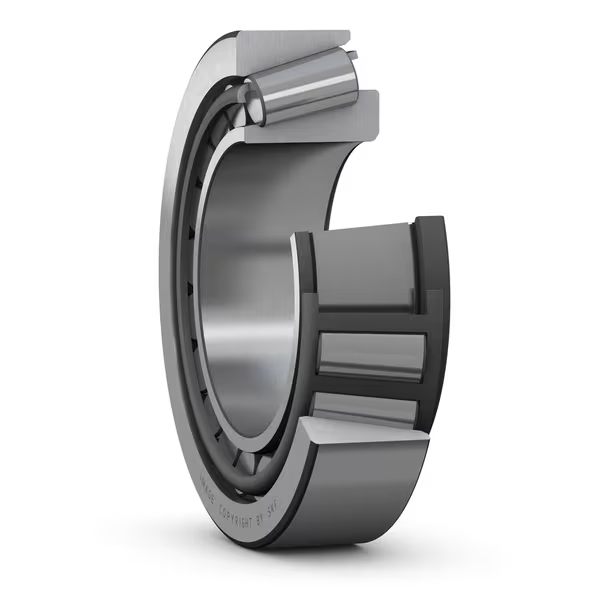
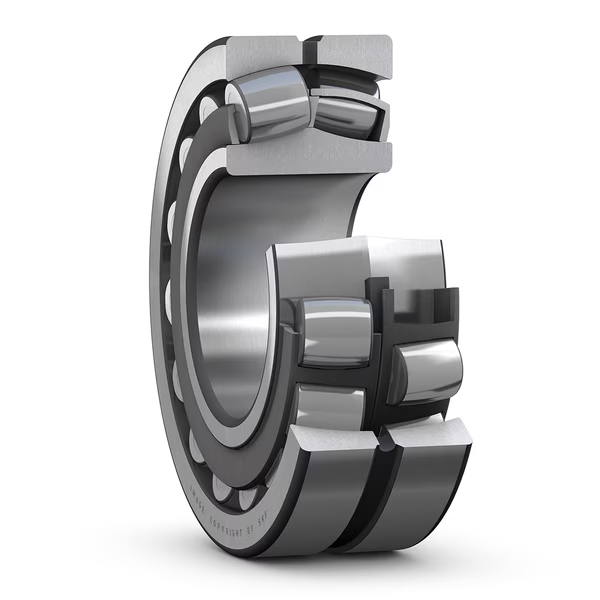
What are eight common rolling-bearing types?
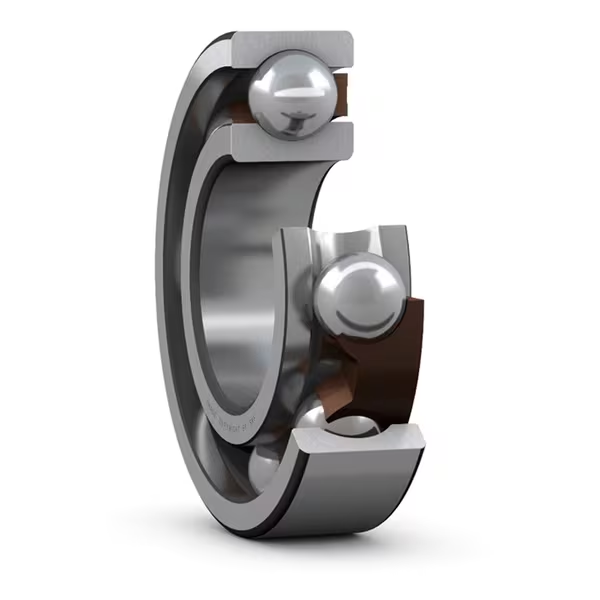
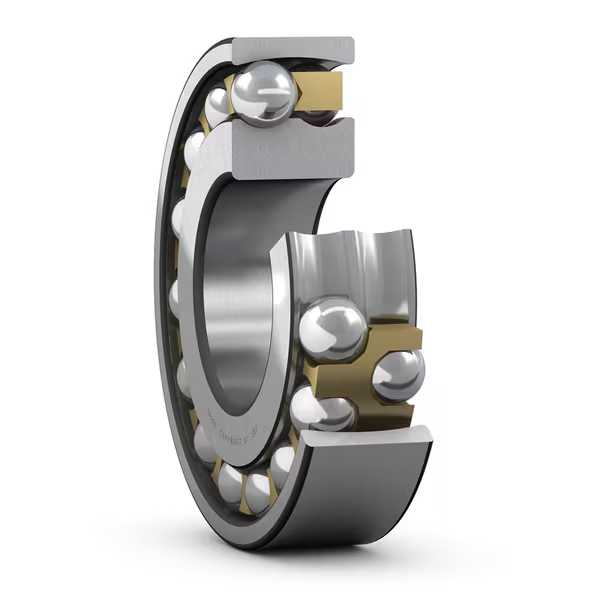
The illustrated list below contains four ball-bearing families and four radial roller-bearing families. Thrust roller bearings, plain bearings, linear guides and mounted units still exist outside that eight-example list.
Eight common rolling-bearing families, with real model examples
These are construction examples, not model recommendations for your machine. The pictures belong to the named example records; exact variants can look different. Use the family page and complete product record to check the specification.
These original sketches show rolling-element profiles, not complete bearing sections or manufacturing drawings. Roller shape is a useful clue; it does not by itself prove the exact model, load rating or installed arrangement.
For an exercise that asks you to draw two complete roller-bearing sections, use the exact construction and its section drawing. These element-profile sketches are not a substitute for a full bearing drawing.
Plain bearings: journal, thrust and articulated forms
“Friction bearing” is often used for a plain bearing; it does not mean every plain bearing runs dry. Likewise, “antifriction bearing” commonly means a rolling-element bearing, not a bearing with zero friction.
A spherical sliding interface permits articulation; a rod end also provides its mounting shank.
Check articulation, sliding pair, load direction and any thread specification.
Beyond the eight examples: fluid-film and magnetic support
In a fluid-film bearing, liquid or gas separates the supporting surfaces under the specified operating conditions. A hydrodynamic design develops its supporting film through relative motion; an externally pressurized design needs a pressure supply. An air bearing is therefore not an ordinary rolling bearing with air substituted for its grease.
A magnetic bearing supports the shaft through magnetic forces. Its support and control system must be considered as a system, not identified from the d×D×B dimensions of a conventional rolling bearing. This guide does not supply validated models or operating limits for these specialist systems.
Turn a type name into a useful model search
Rotation or translation? A shaft rotating in a support and a carriage translating on a rail need different geometry. Linear bearings and guides →
Radial, axial or combined duty? Resolve the load directions and identify which support locates the shaft. Load calculations →
What structure and complete marking? Identify the family first; then retain brand, suffixes and assembly components. Designation decoder →
What size and operating conditions? Use the named dimensions, then check ratings, speed, clearance and lubrication. Dimension and model lookup →
Is it actually interchangeable? Compare the full technical requirement, not just the appearance or shared dimensions. Interchange checklist →
A mounted unit combines a bearing with a housing; a housing alone is not another rolling-element shape. Linear bearings describe guided translation, and cannot be selected by a rotary bearing size alone.
Technical basis: NSK Bearing ABCs and the named product-family references. Diagrams, classification explanation and lookup sequence are original BearingScope content. Model examples are existing catalogue records, not application approvals.
Start with the motion and load
What does a bearing do?
A bearing supports and guides relative movement between machine parts. A rolling bearing uses balls or rollers; a plain bearing uses sliding surfaces. A linear guide supports translation rather than ordinary shaft rotation. These names describe different structures, not different quality grades.
How a rolling bearing works
In a typical radial rolling bearing, balls or rollers run between the raceways of an inner ring and an outer ring. The rolling elements carry load between the rings as relative rotation occurs. A cage, when fitted, keeps the rolling elements separated. Ball bearings use balls; roller bearings use cylindrical, tapered, needle or spherical rollers according to the design. The rolling-element shape and raceway arrangement determine the family, not the brand name.
This is a structural explanation, not a claim of friction-free motion or a complete parts list for every bearing. Some assemblies use prepared shaft surfaces or separate washers instead of a conventional pair of radial rings.
Radial, axial and moment loads
Radial force acts across the shaft axis. Axial or thrust force acts along it. A tilting moment tends to turn the supported member out of alignment. A family name helps identify the load path, but the exact design and arrangement determine what is permitted.
What is a thrust bearing, and how does it work?
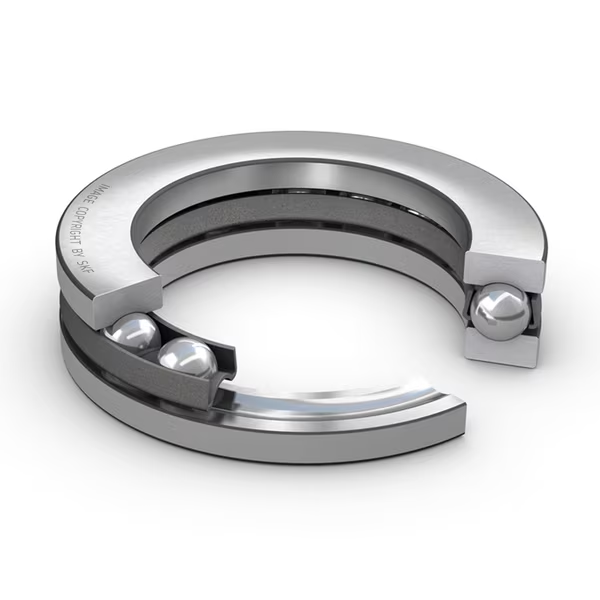
A thrust bearing supports force along the shaft axis. In a rolling thrust design, balls or rollers transmit that force between the specified raceway surfaces while allowing relative rotation. A single-direction thrust ball bearing uses a shaft washer, a housing washer and a ball-and-cage assembly; a double-direction design has two ball-and-cage assemblies and an intermediate shaft washer. Roller thrust designs require their own washer and roller identification.
Single-direction and double-direction describe axial support, not clockwise versus anticlockwise shaft rotation. Thrust ball bearings do not carry radial load; do not extend that rule indiscriminately to every roller thrust construction.
Rail/carriage geometry is not a rotary d×D×B envelope.
Ball bearing types are not one interchangeable family
Use the structure-specific pages for deep groove, angular contact, self-aligning and thrust ball bearings. Loose bearing balls are components, not a complete bearing: a ball diameter alone cannot establish the bearing model or its load rating.
Technical reference basis: NTN Rolling Bearings and Bearing Structure and Types; JTEKT Thrust Ball Bearings. This is a family-identification guide, not an application approval.
Browse by structure and component role
Each original catalogue subtype belongs to one structural group below. Counts refer to loaded records, not manufacturer catalogue completeness. Materials and special features remain separate filters.
No family matches this text. Clear the search to see all groups.
Materials, size classes & specialist designs
Miniature, thin-section, stainless and ceramic describe additional selection needs rather than one universal bearing structure. Choose the structure, then verify the dimensional section and recorded material. Air and magnetic bearings require system-level design and are not represented as ordinary rolling-bearing substitutes.
Manufacturer terminology is retained in the product records. Technical reference basis: JTEKT Basic Bearing Knowledge (boundary dimensions, tolerance classes and lubrication); NSK Bearing ABCs (lubrication, designations and clearance); NTN technical FAQs (closure codes and component interchange); SKF rolling-bearing selection and maintenance references.
Selection workflows and catalogue grouping are BearingScope editorial aids. Verify the current drawing and application requirements before using a candidate. Missing database information is not converted into an assumed match.
Search the consolidated catalogue
Find, filter and compare bearing model data in one place.